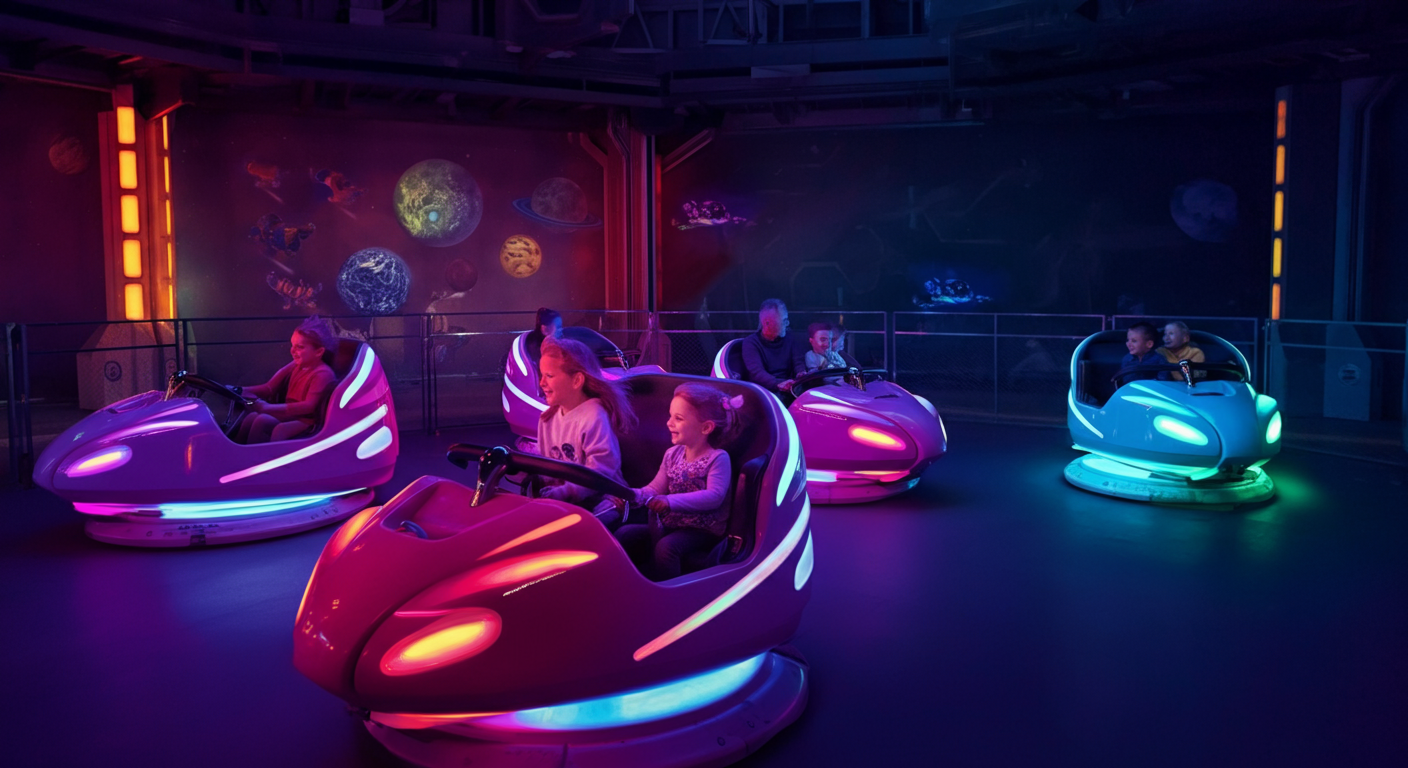
Trackless rides transform family entertainment attractions by introducing dynamic movement, unpredictable paths, and immersive design elements. These systems break free from fixed rails, allowing vehicles to glide smoothly through themed environments. The Dark-ride System market predicts a 12% CAGR from 2026 to 2033, driven by the flexibility and visitor engagement that trackless rides provide. Families and operators see greater value in experiences that feel fresh and interactive on every visit. To explore how these benefits are applied across different settings, check out our overview of trackless ride use cases, from museums to indoor theme parks.
Key Takeaways
- Trackless rides offer flexible movement and immersive storytelling, enhancing guest engagement in family entertainment attractions.
- These systems simplify maintenance and improve safety, allowing operators to focus on delivering memorable experiences without interruptions.
- Trackless rides encourage repeat visits by providing unique adventures each time, appealing to families of all ages.
- Advanced technologies like AI and mixed reality create personalized experiences, making each ride feel fresh and exciting.
- Operators benefit from increased revenue and operational efficiency, as trackless rides require less maintenance and support higher guest capacities.
Trackless Rides vs. Traditional Rides
Defining Trackless Ride Systems
Trackless ride systems use advanced navigation technologies, such as RFID and WiFi, to guide vehicles through themed environments without the need for fixed rails. These vehicles move freely in all directions, creating non-linear paths that enhance storytelling and guest engagement. Operators can easily reprogram routes, allowing for quick adaptation to new themes or layouts. This flexibility makes trackless rides for FEC a popular choice in modern family entertainment attractions.
Key Differences and Benefits
The operational differences between trackless and traditional ride systems shape the guest experience and maintenance needs. The table below highlights these distinctions:
| Feature | Trackless Ride Systems | Traditional Ride Systems |
|---|---|---|
| Movement Flexibility | Can move fluidly in all directions without rails | Fixed paths along a track |
| Maintenance | Easier maintenance without stopping the ride | Requires stopping to remove vehicles for maintenance |
| Guest Experience | Offers non-linear paths for surprises and immersive storytelling | Linear paths with predictable experiences |
| Installation | Fast and seamless installation without docking constraints | Installation requires precise alignment of tracks |
| Charging | Induction charging allows continuous operation | Requires scheduled charging breaks for electric vehicles |
Trackless vehicles simplify maintenance, as technicians can service them without removing them from operation. Safety improves because vehicles can stop at the nearest exit during emergencies. Maintenance costs also tend to be lower, since there is no need for ongoing track refurbishment. The table below compares maintenance focus and costs:
| Type of Ride | Maintenance Focus | Additional Costs |
|---|---|---|
| Trackless Trains | Vehicle drivetrain, tires, steering, electronics | Generally lower due to no track upkeep |
| Traditional Trains | Track maintenance (rail wear, alignment, etc.) | Higher due to ongoing track refurbishment |
Why FECs Are Adopting Trackless Rides
Family entertainment attractions increasingly choose trackless systems for their adaptability and guest appeal. These rides serve all age groups, from toddlers to seniors, and can operate in a variety of environments. Operators appreciate the ability to customize vehicle exteriors for seasonal events or branding. Trackless rides also encourage repeat visits by offering new experiences each time, supporting revenue growth through secondary spending on food, retail, and immersive family rides.
Tip: Trackless rides enhance guest flow and dwell time, aligning with operator goals to maximize attendance and revenue in interactive family rides and space-saving family ride systems.
Technology Behind Trackless Family Entertainment Attractions
Navigation and Sensor Systems
Trackless rides rely on advanced navigation and sensor systems to deliver dynamic experiences in family entertainment attractions. These systems use technologies such as automated guided vehicles, buried wire navigation, Wi-Fi and RFID positioning, and magnetic guidance. Each technology supports flexible movement and precise control. The table below outlines the main navigation methods:
| Technology Type | Description |
|---|---|
| Automated Guided Vehicles | Vehicles that operate without guide rails, allowing for flexible movement patterns. |
| Buried Wire Navigation | Some rides use a buried wire for navigation, providing a basic guiding system. |
| Wi-Fi and RFID Positioning | Advanced rides utilize Wi-Fi and RFID for local positioning, enhancing vehicle versatility. |
| Magnetic Guidance | Magnets in the floor help keep vehicles on track, controlled by a master computer system. |
These navigation systems improve safety and reliability. Operators can route vehicles precisely, ensuring they follow designated paths. Invisible wire or optical navigation allows multiple vehicles to run at the same time, reducing collision risks. Automatic safety protocols direct vehicles to safe stations during technical issues, eliminating manual evacuations. Self-contained designs reduce maintenance needs, which boosts overall reliability.
- Precise vehicle routing enhances safety.
- Multiple vehicles operate simultaneously, minimizing collision risks.
- Automatic safety protocols improve reliability.
- Reduced maintenance needs contribute to operational safety.
Immersive and Interactive Features
Trackless rides for FEC use immersive and interactive features to engage guests. Projection mapping and animatronics create lifelike environments. These technologies serve the story and immersion, rather than drawing attention to themselves.
Rise of the Resistance utilizes cutting-edge technology throughout the experience, from projection mapping and animatronics to trackless ride vehicles. However, none of these technologies calls attention to themselves; they serve the story and immersion. You don’t think, 'What amazing projection technology!' You think, 'I just saw Kylo Ren use the Force!'
Interactive family rides leverage AI and biometric sensors to adapt to guest input. These features personalize the experience, making each ride unique. Augmented reality and adaptive storytelling transform traditional rides into multidimensional journeys. Guests participate actively, and sensory effects amplify immersion.
Narrative design powered by AI fosters rides that adapt to the guest’s input via biometric sensors that track heart rates and facial expressions. Guided and personalized outcomes shaped by AI interactivity create compelling reasons to revisit, as each ride provides a unique experience.
- Traditional rides are often passive, while interactive rides allow for active participation.
- Interactive features adapt to guest inputs, creating personalized experiences that enhance engagement.
- Sensory effects in interactive rides amplify immersion compared to standard thrill rides.
These advancements encourage repeat visits, as guests seek to relive unique narratives and experiences offered by immersive family rides.
Space-Saving and Flexible Design
Space-saving family ride systems offer flexibility for operators in family entertainment attractions. Trackless rides do not require physical tracks, which simplifies setup and allows for flexible placement. Operators can relocate these systems easily to adapt to changing space constraints.
- Trackless ride systems allow for flexible placement.
- They can be easily relocated to adapt to different space constraints.
- These systems do not require physical tracks, which simplifies initial setup.
This flexibility supports customization of routes to fit venue layouts. Operators can accommodate larger passenger capacities, reducing wait times and improving operational flow. Enhanced operational efficiency leads to cost savings for operators. The table below highlights these benefits:
| Feature | Benefit |
|---|---|
| Flexibility in Route Design | Allows customization of routes to fit venue layout, enhancing visitor experience. |
| Larger Passenger Capacity | Accommodates more guests, reducing wait times and improving operational flow. |
| Enhanced Operational Efficiency | Streamlines operations, leading to potential cost savings for operators. |
Trackless rides for FEC provide adaptability and operational advantages. Operators can maximize attendance and revenue by offering interactive family rides and space-saving family ride systems that appeal to a wide range of guests.
Impact on Guest Experience in Family Entertainment Attractions
Immersion and Engagement
Trackless rides redefine immersion for guests in family entertainment attractions. These systems allow vehicles to move independently, creating unpredictable paths and dynamic storytelling. Guests experience a sense of wonder as each ride can differ from the last. For example, Luigi’s Rollickin’ Roadsters offers different dance sequences on every ride, making each journey unique. Star Wars: Rise of the Resistance uses frantic, back-and-forth movements to simulate a battle scenario, keeping guests on the edge of their seats. Mickey and Minnie’s Runaway Railway splits and reconnects train cars, adding chaos and excitement to the narrative. Enchanted Tale of Beauty and the Beast lets guests board trackless cups that dance to music, immersing them in the story.
Trackless technology enables immersive family rides that blend physical sets, projection mapping, and animatronics. Guests do not simply observe the story—they become part of it. The unpredictability of movement heightens engagement, ensuring that families remain captivated from start to finish.
Accessibility and Safety
Trackless rides improve accessibility for a wide range of guests. These systems feature ADA-compliant options, smooth boarding processes, and comfortable accommodations for elderly riders. The table below highlights key accessibility features:
| Feature | Description |
|---|---|
| ADA-compliant options | Ensures compliance with accessibility standards |
| Smooth boarding | Facilitates easier access for disabled guests |
| Suitable for elderly riders | Provides comfort and safety for older guests |
Safety remains a top priority in trackless ride design. Operators use advanced control systems to prevent unwanted contact between vehicles, similar to bumper cars but without collisions. Multiple redundant safety systems meet high industry standards. Smart vehicle programming issues warnings for potential hazards, such as nearby cliffs, enhancing rider awareness. Advanced suspension and treads allow vehicles to navigate over obstacles like boulders and debris, ensuring a safe and comfortable experience for all.
| Safety Feature | Description |
|---|---|
| Control over environment | Vehicles operate without unwanted contact, reducing collision risks |
| Redundant safety systems | Multiple systems ensure high safety standards |
| Smart vehicle programming | Vehicles issue warnings for hazards, increasing rider awareness |
| Advanced suspension | Vehicles navigate obstacles, maintaining a safe ride |
These features make trackless rides for FEC accessible and secure, appealing to families with diverse needs.
Repeatability and Personalization
Trackless rides encourage repeat visits by offering personalized and interactive experiences. Guests can control aspects like lighting and music, adding a personal touch to each journey. Vibrant designs and festive decorations create an engaging atmosphere for children and families. Interactive family rides feature control panels that allow guests to interact with the environment, enhancing enjoyment and participation. Memorable elements, such as simulated steam effects, make each ride unforgettable and motivate guests to return.
| Feature | Description |
|---|---|
| Customizable Options | Users control lighting and music, personalizing each ride |
| Vibrant Designs | Bright colors and decorations engage children and families |
| Interactive Features | Control panels enable user interaction, increasing enjoyment |
| Memorable Experiences | Unique effects encourage repeat visits |
Space-saving family ride systems also allow operators to change routes and themes easily, ensuring that no two visits feel the same. This adaptability supports interactive family rides that remain fresh and exciting, driving long-term guest loyalty.
Real-World Applications & ROI
FEC Case Studies
Operators across the globe have adopted trackless rides for FEC to create memorable guest experiences and boost business performance. For example, a leading indoor park in Asia introduced immersive family rides that blend projection mapping with interactive elements. Guests now enjoy unique journeys each visit, which has led to a 20% increase in repeat attendance. In North America, a popular children’s entertainment center installed space-saving family ride systems. The flexible layout allowed the venue to add more attractions without expanding its footprint. As a result, the center saw higher throughput per hour and improved guest flow.
Note: Operators report that interactive family rides encourage longer dwell times and greater ancillary spending on food and merchandise.
Operational and Financial Benefits
Trackless rides deliver measurable operational and financial advantages for family entertainment attractions. Operators monitor several key metrics to evaluate success:
| Metric | Description |
|---|---|
| Revenue Generation | Total income generated from the ride. |
| Operational Costs | Expenses incurred in running the ride. |
| Return on Investment (ROI) | Measure of profitability relative to the investment made. |
| Ridership per Day | Average number of riders using the ride daily. |
| Throughput per Hour | Number of riders accommodated per hour. |
| Uptime Percentage | Percentage of time the ride is operational. |
| Average Dwell Time | Average time spent by riders on the ride. |
| Ancillary Spend per Rider | Additional spending by each rider on other services. |
| Customer Satisfaction Scores | Feedback on the queue experience and ride comfort. |
Operators value the high uptime percentage and low operational costs of trackless systems. These rides require less maintenance than traditional attractions, which helps maximize revenue generation. Flexible layouts support higher ridership per day and throughput per hour. Customer satisfaction scores often rise due to smoother boarding and more engaging experiences. Increased average dwell time and ancillary spend per rider further improve the return on investment.
Future Trends for Trackless Rides
Innovations in Ride Design
Trackless rides continue to evolve with new design innovations that enhance guest engagement and operational flexibility. Designers now use autonomous navigation to create unpredictable movement patterns, which adds surprise and excitement to every ride. Vehicles can move in any direction, rotate 360°, and follow customizable paths. This flexibility allows for more complex attraction layouts and dynamic storytelling. Many new systems feature modular components, so operators can easily update or expand the ride experience. Mixed reality technology also plays a growing role, blending physical sets with digital overlays to create immersive family rides that adapt to guest interactions.
- Autonomous navigation enables unpredictable movement and dynamic storytelling.
- Modular ride systems allow for easy updates and customization.
- Mixed reality integrates digital and physical elements for deeper immersion.
Expanding Role in FECs
Trackless rides are becoming more common in family entertainment centers worldwide. Major parks like Disney have set the standard with attractions such as Star Wars: Rise of the Resistance and Remy’s Ratatouille Adventure. Smaller venues now benefit from maturing technology, which makes installations more affordable and accessible. Companies like CAVU Designwerks and KUKA Robotics introduce new ride systems that fit within existing structures and offer features like hill-climbing, drifting turns, and high-end simulation. These advancements support interactive family rides and space-saving family ride systems, helping operators maximize guest capacity and satisfaction.
| Product Name | Features |
|---|---|
| Dynamic Mover | Optical navigation, higher speeds, hill-climbing, 6 riders per vehicle |
| Multi Dimension Mover | Advanced motion, drifting turns, simulator elements |
| Rogue Rides | Omnidirectional movement, customizable sound and interactivity, fits existing venues |
What’s Next for Family Entertainment Attractions
Industry experts predict strong growth for immersive dark rides and trackless attractions through 2035, especially among teens, families, and repeat visitors. New technologies like wireless navigation and high-capacity batteries will improve efficiency and reduce costs. Mixed reality and mecanum wheel technology will further transform the guest experience, offering unique journeys every visit. Family entertainment attractions will continue to adopt trackless rides for FEC, interactive family rides, and space-saving family ride systems to meet rising demand for innovation and repeatable fun.
Conclusion
Trackless rides continue to transform family entertainment attractions by delivering immersive, flexible, and interactive experiences. Families benefit from:
- Engaging journeys with unpredictable movement and active participation
- Unique adventures on every visit, encouraging repeat attendance
- Occasional technical challenges due to advanced systems
Ongoing innovations promise even more fluid and exciting attractions, raising industry standards and guest satisfaction. Operators gain operational advantages and increased revenue as technology evolves.
FAQ
What makes trackless rides different from traditional rides?
Trackless rides operate without fixed rails. Vehicles move freely, creating unpredictable paths and immersive experiences. Family entertainment attractions use these systems to offer dynamic storytelling and greater flexibility.
How do trackless rides for FEC improve guest safety?
Operators use advanced sensors and navigation systems. Vehicles stop automatically during emergencies. Space-saving family ride systems reduce collision risks and provide smooth boarding for all guests.
Can immersive family rides support accessibility?
Many immersive family rides include ADA-compliant features. Smooth boarding and comfortable seating help elderly guests and those with disabilities enjoy interactive family rides in family entertainment attractions.
Why do operators prefer space-saving family ride systems?
Space-saving family ride systems allow flexible layouts. Operators maximize guest capacity and adapt attractions quickly. These systems help family entertainment attractions increase revenue and reduce operational costs.
Are interactive family rides suitable for repeat visits?
Interactive family rides offer unique experiences each time. Guests control elements like lighting and music. Family entertainment attractions benefit from increased repeat attendance and higher guest satisfaction.


