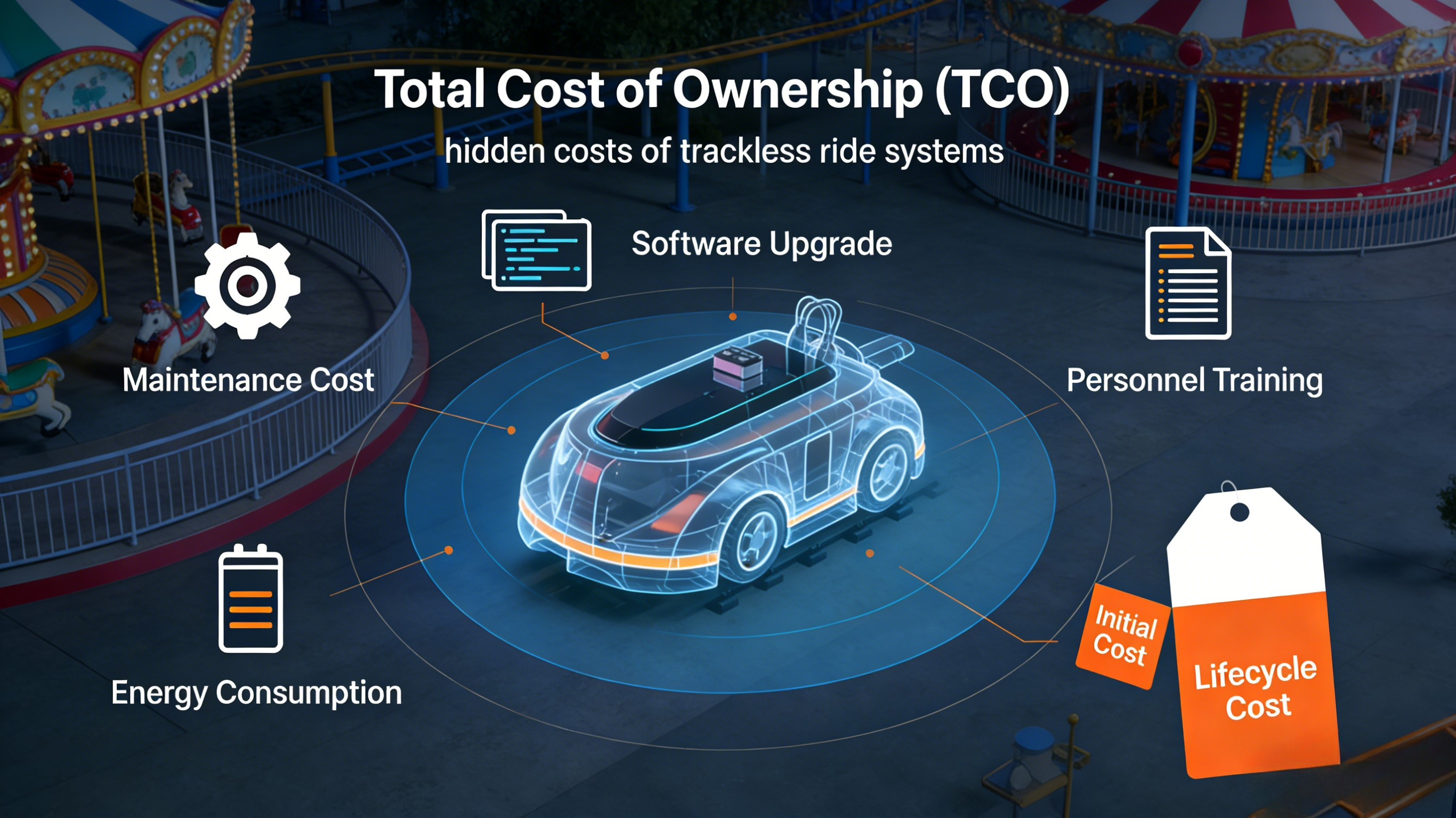
When purchasing a Trackless Dark Ride system, many buyers make a costly mistake: focusing solely on the initial hardware quote provided by manufacturers, while ignoring the Total Cost of Ownership (TCO) that the equipment will incur over the next several years or even more than a decade. In fact, a "pure price-driven" decision based only on the lowest price usually leads to high maintenance costs, more frequent downtime, and poor visitor experiences in the later stage.
To ensure your Return on Investment (ROI), you must fully review the hidden costs of trackless rides before signing a contract. This buyer's guide will deeply break down those easily overlooked hidden expenses to help you make the most informed business decisions.
Key Takeaways
-
Don’t just focus on the initial quote: The initial purchase price is just the tip of the iceberg; you must evaluate the long-term attraction lifecycle cost.
-
Pay attention to high-frequency maintenance expenses: Trackless ride maintenance cost is a major part of the long-term budget, including daily wear and tear of Automated Guided Vehicles (AGVs), spare parts replacement, etc.
-
Software and system upgrades: Navigation systems and multi-vehicle scheduling software require regular licensing and upgrades to ensure safety and system stability.
-
Personnel and operational costs: Professional operator training, comprehensive technical documentation, and daily energy consumption (such as AGV charging) will continue to accumulate over time.
I. The Danger of Price-Only Decisions
Many purchasers are easily attracted by the seemingly lowest quote during bidding. However, adopting a low-cost system may mean that the system lacks advanced safety certifications, reliable after-sales support, or uses hardware that is prone to obsolescence. In the long run, hidden costs of trackless rides will consume your budget in unforeseen ways: frequent failures will lead to park shutdowns, long waiting periods for spare parts will tax operational patience, and poor visitor feedback will ultimately damage brand reputation.
Risk Reminder: If you ignore the evaluation of the total cost of ownership (TCO), your project budget is highly likely to exceed the limit in the first year of operation, and you will face higher safety compliance risks.
II. A Deep Dive into the Core Hidden Costs of Trackless Rides
To accurately calculate the attraction lifecycle cost, we need to break down the hidden costs into the following core dimensions:
1. Ongoing Maintenance and Spare Parts Costs (Trackless Ride Maintenance Cost)
Trackless rides rely on complex sensor networks, wireless communications, and AGV chassis. This means that trackless ride maintenance cost is much higher than that of traditional tracked amusement rides.
-
Routine and Preventive Maintenance: To comply with international safety standards (such as CE, ASTM), you need to conduct strict preventive inspections on a regular basis.
-
Spare Parts and Consumables: Wear of AGV drive wheels, life attenuation of battery packs, and aging of sensors all require regular replacement. If these spare parts costs are not included in the initial contract, the cost of purchasing them individually later will be very high.
2. Software Upgrades and Technical Licensing (Software & Licensing)
The brain of a trackless ride is its underlying navigation and scheduling system.
-
Software Updates: System software is not a "one-time purchase". Regular software updates are necessary to fix potential vulnerabilities, improve the efficiency of multi-vehicle scheduling, and support new interactive media.
-
Compatibility and Expansion Licenses: If you plan to scale up, add vehicles, or modify driving routes in the future, some closed systems may charge you high fees for reprogramming or secondary authorization.
3. Operational, Energy, and Training Costs (Operational & Training Costs)
-
Energy Consumption: The all-day operation and repeated charging of multiple AGV vehicles will generate a significant electricity expense. In addition, if the vehicles have strict requirements on ground materials, you may also need to frequently repair the wear of custom floors.
-
Staff Training and Technical Documentation: Safety standards require operators and maintenance teams to receive professional training from manufacturers. Costs for re-training due to staff turnover, as well as obtaining and updating operation manuals (in Chinese/English) and emergency procedure documents, are long-term hidden expenses.
III. Evaluating Attraction Lifecycle Cost: Maximizing Long-Term Value
For an intuitive comparison, let’s look at the differences in long-term costs between the "price-only" and "value-based (full lifecycle)" decision-making models:
| Decision Approach | Short-Term Cost (Initial Purchase Cost) | Long-Term Cost (Lifecycle Cost) | Safety Risk | Upgrade Flexibility |
| Price-Only | Low | High - Frequent failures and expensive spare parts | High | Limited |
| Value-Based | Moderate | Lower - Stable operation and controllable maintenance | Low | High |
💡 Tip (Expert Tip): When requesting quotes from suppliers, be sure to ask them to provide a "multi-year cost forecast" including installation, operation, spare parts, software licensing, and training. To understand industry benchmark ratios for these costs and a more detailed calculation model, dive deeper into our cluster's core guide.
IV. Avoiding Pitfalls: Buyer's Decision Checklist
Before signing the final contract, use this checklist to ensure you have locked in all potential hidden costs of trackless rides:
-
Spare Parts Supply Terms: Does the contract clearly specify the pricing mechanism and delivery cycle for core spare parts?
-
Software Upgrade Agreement: Are mainstream software updates and patches during the lifecycle included in the support package?
-
Maintenance and SLA: Does it include 7x24-hour technical support, remote diagnosis, and clear on-site response time (SLA)?
-
Comprehensive Training Inclusion: Is complete operator/maintenance personnel guidance and a full set of compliance documentation provided?
-
Scalability Costs: If an additional AGV is added in the future, will additional fees be charged for software authorization?
Conclusion & Call to Action (CTA)
Choosing a trackless dark ride manufacturer is essentially choosing a strategic partner for up to a decade. True value is not the lowest initial hardware quote, but a transparent, controllable, and efficient attraction lifecycle cost.
If you are planning a complex trackless ride project and want to accurately evaluate its full lifecycle budget to avoid the trap of hidden costs, please contact our expert team immediately to get a customized TCO evaluation plan.
Frequently Asked Questions (FAQ)
Q1: What are the biggest hidden costs trackless ride buyers face? The main hidden costs include: daily preventive maintenance fees, replacement of consumable spare parts such as batteries and sensors, annual upgrade authorization for software and navigation systems, as well as long-term technical personnel training and venue energy consumption costs.
Q2: How can I accurately evaluate the attraction lifecycle cost before buying? You should ask each candidate supplier to provide a multi-year forecast table including "TCO (Total Cost of Ownership)", which must detail the initial vehicle cost, installation and commissioning fees, maintenance contract fees, estimated spare parts fees, and software licensing fees, and cross-calculate it with your estimated ticket revenue for ROI (Return on Investment).
Q3: Is trackless ride maintenance cost significantly higher than tracked rides? Yes. Because trackless systems rely on AGVs, complex redundant positioning systems, and wireless communication networks, they have higher requirements for batteries, tire wear, and software updates. However, a well-designed system can balance these costs in the long run through remote diagnostics and intelligent scheduling, significantly reducing manual troubleshooting time.


